---
title: Module adjustment and tuning
description: It is possible to boost and tune almost every module in the control panel. Boosting and tuning parameters are used to get the desired output and product recommendations. Examples of how to adjust and
---
[Skip to content](https://content.raptorservices.com/help-center/module-adjustment-and-tuning#main-content)
![raptor-qntm-logo\_horizontal\_gradient.png\]](https://content.raptorservices.com/hs-fs/hubfs/raptor-qntm-logo_horizontal_gradient.png?height=40&name=raptor-qntm-logo_horizontal_gradient.png)
Open main navigation
Close main navigation
- [Go to raptorservices.com](https://raptorservices.com/)
[Go to raptorservices.com](https://raptorservices.com/)
Hello. How can we help you?
- There are no suggestions because the search field is empty.
1. [Help Center](https://content.raptorservices.com/help-center?hsLang=en)
2. [Website Recommendations](https://content.raptorservices.com/help-center/website-recommendations?hsLang=en)
3. [Tuning Parameters](https://content.raptorservices.com/help-center/website-recommendations?hsLang=en#tuning-parameters)
# Module adjustment and tuning
### What is module tuning?
Every Raptor recommendation module, on your website or in email, can be boosted and tuned using weights. Tuning doesn't change which products a module can show, it changes the order they come out in, so you can favour recently viewed products, repeat purchases, complementary items, similar products, or searched-for products, depending on what fits your business. This article covers the 6 weights most commonly adjusted. For the complete list, including weights for co-purchase-based cross-selling, brand and category associations, and near-duplicate suppression, see [R*ecommendation module weights: full parameter reference*](https://content.raptorservices.com/help-center/e-mail-recommendation-module-weights-full-parameter-reference?hsLang=en).
#### Prerequisites
- A live recommendation module already returning results. Tuning changes ranking, it doesn't create data, so the module needs a working candidate set and enough tracking history first.
- Access to the module's settings in the Raptor Control Panel.
Tuning parameters
Each weight uses the same scale, from -20 to +20. The sign decides the direction (push down or promote), the number decides how strongly. Most weights are available on both Website and E-mail modules; two are e-mail-only .
**Cross-sell weight** (`CrossSellWeight`)
What it does: surfaces products that complement what the visitor or subscriber has already bought or added to their basket.
💡 **Example**: trousers bought, the scarf and matching top rise in the recommendations.
**Look-alike weight** ( `LookAlikeWeight`)
What it does: surfaces products similar to what the visitor or subscriber has viewed or bought.
💡 **Example**: a floral dress viewed, other dresses in the same style rise.
**Buy history weight** (`BuyHistoryWeight`)
What it does: pushes down or re-promotes what the visitor or subscriber has already bought, depending on the sign. Turn it up for businesses with repeat purchases, such as grocery, DIY, or many B2B categories. Set it positive if repurchasing is the goal.
💡 **Example**: a jacket bought, other fashion items get pushed down while food items get re-promoted.
**Visit history weight** (`VisitHistoryWeight`)
What it does: boosts products the visitor or subscriber has previously viewed. Turn it up when people tend to visit a product several times before buying, common in fashion, sportswear, or travel. Set it negative if you'd rather surface products they haven't seen yet.
💡 **Example:** three pairs of sandals viewed without buying, they rise in the ranking.
**Basket weight** (`BasketWeight`) , e-mail only
What it does: almost always negative in practice, pushes down whatever's already in the subscriber's basket so it isn't re-shown, since there's usually little point recommending something already added to the basket.
💡 **Example**: a scarf in the basket isn't shown again, but it's used as the basis for a cross-sell suggestion.
**Search history weight** (`SearchHistoryWeight`), e-mail only
What it does: surfaces what the subscriber searched for, an explicit signal of intent.
💡 **Example**: a search for "winter coat", coats rise in the ranking.
🔍 **Note:** buy history weight and visit history weight are often mutually exclusive in practice, most businesses lean on one or the other. Look-alike weight and cross-sell weight, on the other hand, are commonly used together across industries. If you want the module to automatically detect which of the two strategies to apply, set cross-sell weight and look-alike weight to the same value.
### **Other tuning options**
**Merchandising Boosts** (`MerchandisingBoost1Weight`): boosts specific products by a value from your product schema, for example high margin, high stock, or private label products. Works across Website and E-mail modules alike. Set automatically when a campaign is created in Merchandising, so you don't normally need to touch it directly. See [*Introduction to Merchandising*](https://content.raptorservices.com/help-center/introduction-to-merchandising?hsLang=en) for the full boosting workflow.
**Serendipity score**: balances popularity against diversity in the recommendations. If the same popular products keep showing up, increase the serendipity score to add more variety.
**🔍 Note:** A few modules, such as `GetPIMRelatedItems`, the content-based modules, and the Personal Shopping Assistant, offer tuning options beyond the 6 weights above, built specifically for what that module does. See the "Recommendation Strategies" section of [Website Recommendations](https://content.raptorservices.com/help-center/website-recommendations?hsLang=en#recommendation-strategies) or [Mail Recommendations](https://content.raptorservices.com/help-center/mail-recommendations?hsLang=en#recommendation-strategies) for the article covering your specific module, or [Recommendation module weights: full parameter reference](https://content.raptorservices.com/help-center/e-mail-recommendation-module-weights-full-parameter-reference?hsLang=en) for the complete parameter-level list.
### How to adjust a module's weights
1. In the Raptor Control Panel, go to **Recommendations**, then **Website** or **E-mail**, and open the module you want to adjust.
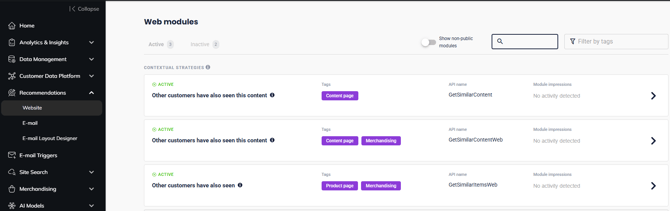
2. Test the module's current output by entering the mandatory input parameter, such as a category, product, or brand ID, in the first box on the module page. Find valid IDs by clicking the magnifying glass and pulling one from the live tracking stream.
3. To personalize the test, include a cookie ID or user ID for Website modules, or a subscriber's RUID (Raptor E-mail Marketing ID) for E-mail modules, in the optional input parameters. This turns the test output into what that specific visitor or subscriber would see
4. Adjust the weights you need in the optional input parameters, then test again to see how the order of results changes.
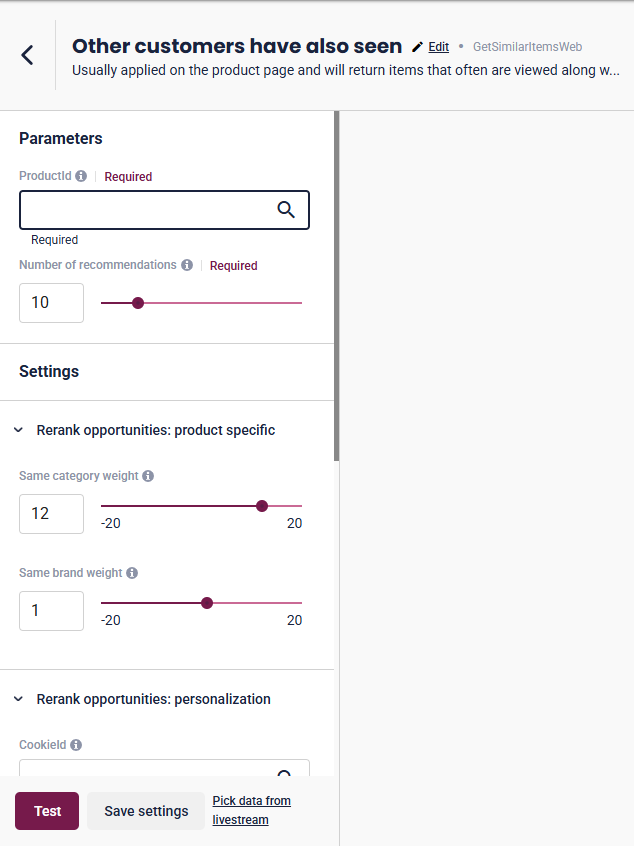
5. Save your changes once you're happy with the result.
⚠️ **Warning:** changing a module's weights changes the order of results for every page or email using that module. Test with real profiles, including ones with no history, before rolling out a change.
🔍 **Note:** recommended starting values differ a lot by industry. See [*Recommendation module settings by industry*](https://content.raptorservices.com/help-center/recommendation-module-settings-by-industry?hsLang=en) for suggested values by business type.
- [Welcome to Raptor](https://content.raptorservices.com/help-center/welcome-to-raptor?hsLang=en#main-content)
- [Introduction](https://content.raptorservices.com/help-center/welcome-to-raptor?hsLang=en#introduction)
- [Analytics & Insights](https://content.raptorservices.com/help-center/analytics-insights?hsLang=en)
- [Data Management](https://content.raptorservices.com/help-center/data-management?hsLang=en#main-content)
- [Implementing Tracking](https://content.raptorservices.com/help-center/data-management?hsLang=en#implementing-tracking)
- [Implementing Raptor Recommendation](https://content.raptorservices.com/help-center/data-management?hsLang=en#implementing-raptor-recommendation)
- [Email Marketing Integration](https://content.raptorservices.com/help-center/data-management?hsLang=en#email-marketing-integration)
- [The Data Manager](https://content.raptorservices.com/help-center/data-management?hsLang=en#the-data-manager)
- [Streaming API](https://content.raptorservices.com/help-center/data-management?hsLang=en#streaming-api)
- [Destinations](https://content.raptorservices.com/help-center/data-management?hsLang=en#destinations)
- [Customer Data Platform](https://content.raptorservices.com/help-center/customer-data-platform?hsLang=en#main-content)
- [Introduction](https://content.raptorservices.com/help-center/customer-data-platform?hsLang=en#introduction)
- [Profile Unification](https://content.raptorservices.com/help-center/customer-data-platform?hsLang=en#profile-unification)
- [Audience Builder](https://content.raptorservices.com/help-center/customer-data-platform?hsLang=en#audience-builder)
- [Audience Insights](https://content.raptorservices.com/help-center/customer-data-platform?hsLang=en#audience-insights)
- [Calculated Attributes](https://content.raptorservices.com/help-center/customer-data-platform?hsLang=en#calculated-attributes)
- [Activations](https://content.raptorservices.com/help-center/customer-data-platform?hsLang=en#activations)
- [Single Customer View](https://content.raptorservices.com/help-center/customer-data-platform?hsLang=en#single-customer-view)
- [CDP Export API](https://content.raptorservices.com/help-center/customer-data-platform?hsLang=en#cdp-export-api)
- [Website Recommendations](https://content.raptorservices.com/help-center/website-recommendations?hsLang=en#main-content)
- [Introduction](https://content.raptorservices.com/help-center/website-recommendations?hsLang=en#introduction)
- [Recommendation Strategies](https://content.raptorservices.com/help-center/website-recommendations?hsLang=en#recommendation-strategies)
- [Feeds](https://content.raptorservices.com/help-center/website-recommendations?hsLang=en#feeds)
- [Tuning Parameters](https://content.raptorservices.com/help-center/website-recommendations?hsLang=en#tuning-parameters)
- [Working with the Raptor API](https://content.raptorservices.com/help-center/website-recommendations?hsLang=en#working-with-the-raptor-api)
- [Mail Recommendations](https://content.raptorservices.com/help-center/mail-recommendations?hsLang=en)
- [E-mail Triggers](https://content.raptorservices.com/help-center/e-mail-triggers?hsLang=en#main-content)
- [Get started](https://content.raptorservices.com/help-center/e-mail-triggers?hsLang=en#get-started)
- [E-mail Trigger Documentation](https://content.raptorservices.com/help-center/e-mail-triggers?hsLang=en#e-mail-trigger-documentation)
- [E-mail trigger integrations](https://content.raptorservices.com/help-center/e-mail-triggers?hsLang=en#e-mail-trigger-integrations)
- [Site Search](https://content.raptorservices.com/help-center/site-search?hsLang=en#main-content)
- [Search Tracking](https://content.raptorservices.com/help-center/site-search?hsLang=en#search-tracking)
- [Introduction](https://content.raptorservices.com/help-center/site-search?hsLang=en#introduction)
- [Implementing Site Search](https://content.raptorservices.com/help-center/site-search?hsLang=en#implementing-site-search)
- [Search Ranking & Recommendations](https://content.raptorservices.com/help-center/site-search?hsLang=en#search-ranking-recommendations)
- [Reporting](https://content.raptorservices.com/help-center/site-search?hsLang=en#reporting)
- [Merchandising](https://content.raptorservices.com/help-center/merchandising?hsLang=en#main-content)
- [Introduction to Merchandising](https://content.raptorservices.com/help-center/merchandising?hsLang=en#introduction-to-merchandising)
- [Boosted Campaigns](https://content.raptorservices.com/help-center/merchandising?hsLang=en#boosted-campaigns)
- [Customized Feeds](https://content.raptorservices.com/help-center/merchandising?hsLang=en#customized-feeds)
- [AI Models](https://content.raptorservices.com/help-center/ai-models?hsLang=en#main-content)
- [Customer Lifetime Value](https://content.raptorservices.com/help-center/ai-models?hsLang=en#customer-lifetime-value)
- [Administration](https://content.raptorservices.com/help-center/administration?hsLang=en#main-content)
- [Trust Center](https://content.raptorservices.com/help-center/administration?hsLang=en#trust-center)
- [User Management](https://content.raptorservices.com/help-center/administration?hsLang=en#user-management)
- [Operational Insights](https://content.raptorservices.com/help-center/administration?hsLang=en#operational-insights)
- [Data Retention](https://content.raptorservices.com/help-center/administration?hsLang=en#data-retention)
[](https://www.raptorservices.com/)
raptorsmartadvisor.com Help Center
Copyright © 2026, Raptor Services A/S