![raptor-qntm-logo_horizontal_gradient.png]](https://content.raptorservices.com/hs-fs/hubfs/raptor-qntm-logo_horizontal_gradient.png?height=40&name=raptor-qntm-logo_horizontal_gradient.png)
What is server-side tracking?
Raptor's standard tracking implementation uses a JavaScript snippet that runs in the browser. In some situations this is not possible: server-side rendering environments, native mobile apps (iOS or Android), and headless or app-based storefronts may not have a browser context where JavaScript can run. In these cases, you can send tracking events directly to Raptor's tracking endpoint using a plain HTTP GET request instead.
The data collected is the same. The difference is that the request is made from your server or app rather than from the visitor's browser.
👀 Use case: A native mobile app for iOS or Android cannot run the Raptor JavaScript snippet. The app instead calls the tracking endpoint directly whenever a user views a product, adds an item to the basket, or completes a purchase.
How server-side tracking works
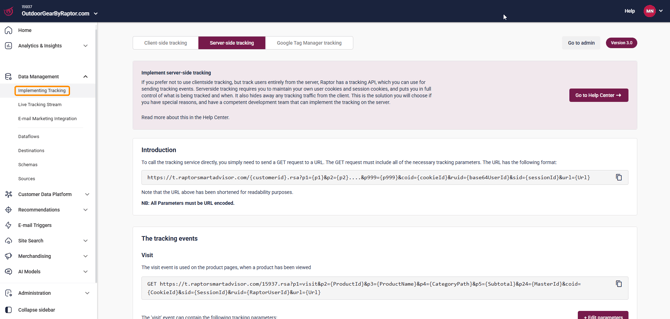
Each tracking event is sent as a GET request to the following endpoint:
https://t.raptorsmartadvisor.com/[customerid].rsa?p1=[p1]&p2=[p2]....&p999=[p999]&coid=[cookieId]&ruid=[base64UserId]&sid=[sessionId]
Replace [customerid] with your Raptor customer ID. The remaining parameters are described in the table below.
⚠️ All parameter values must be URL encoded before sending.
Parameters
| Parameter | Description | Required |
|---|---|---|
| p1 - p999 | Event data parameters: event type, product ID, category ID, and other tracking fields. The exact parameters available to your account are listed in the Raptor Control Panel under Data Management > Implement Tracking. Parameters can differ between accounts. | Yes |
| coid | Cookie ID. A GUID that is unique per user. Must be included in every tracking request. Used by Raptor's personalisation modules to build user profiles. | Yes |
| sid | Session ID. A GUID that is unique per session. Must be included in every tracking request. Used for session-based KPI reporting in Raptor. | Yes |
| ruid | A base64-encoded user ID, typically the visitor's email address or your internal customer ID. Send this when the user is known (logged in). Used for profile unification across devices. | When available |
🔍 Note: The coid is the equivalent of the rsaReaId cookie set by the JavaScript tracker. If your integration spans both browser and server-side contexts, use the same GUID value in both to ensure events are attributed to the same user profile.
Finding your parameter list
The exact p1-p999 parameter mapping for your account is defined during implementation and can be looked up in the Control Panel:
- In the Raptor Control Panel, expand Data Management in the left sidebar.
- Click Implement Tracking.
- Your account's parameter list is shown here, including the event types and field mappings relevant to your setup.